Sun Jie
The Killing RoomSun Jie is an acrobatic performer whose wife, Wu Liyao, disappears while he is away from the demands of their troupe. When Li Yan and Nien Mei-Ling question him, Sun Jie supplies a neglected lead: Wu Liyao had told him that a man was repeatedly watching her. Later, his grief over her death opens onto a more intimate history of their marriage, including the abortion he bullied her into having and the young daughter left in his mother’s care. His testimony connects the investigation’s search for a killer to the ordinary, painful circumstances of the life that was taken.
Identity and Introduction
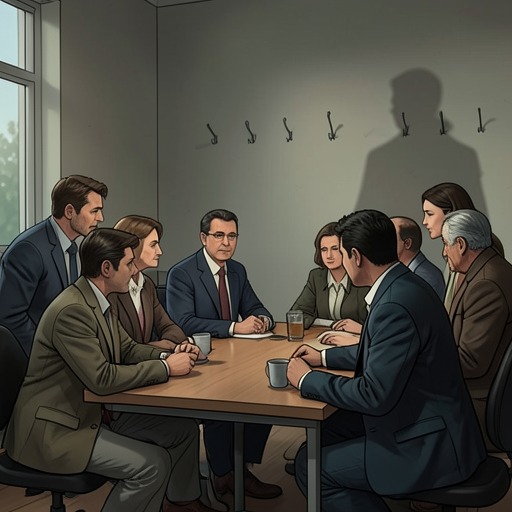
Li Yan and Nien Mei-Ling first find Sun Jie in a temple prayer room, seated alone at the end of a row of chairs while monks read silently around a long table. He wears a shabby blue suit and sits forward with clasped hands and bowed head. Li Yan initially takes him for an older man, then realizes he is perhaps not yet thirty, even younger than his missing wife. The contrast between the young husband and the stillness of the room gives his first appearance a quality of suspended grief.
When Li Yan asks whether he is Sun Jie and says the police want to discuss his wife, hope briefly lights Sun Jie’s eyes before fear replaces it. He glances toward the monks and refuses to speak there. He leads Li Yan and Nien Mei-Ling through two circular openings into a deserted square beneath the monks’ rising residential balconies. Laundry hangs from plastic lines overhead; the chanting and drumbeat of the temple seem distant. In this enclosed space, he turns to the investigators and asks whether Wu Liyao is dead. His first concern is not an explanation but an answer.
Wu Liyao’s Disappearance
Li Yan tells Sun Jie that the police have recovered a woman’s body that may be his wife’s, but decomposition has made identification difficult. Sun Jie remains outwardly still and asks what makes the investigators think the body is Wu Liyao. He agrees to identify it, and a later scene confirms that he does so at the mortuary. His restraint there does not mean an absence of grief: when the two men meet again, Li Yan recalls that Sun Jie had not cried while identifying his wife.
Asked what happened before Wu Liyao disappeared, Sun Jie says she went shopping one Saturday morning and never returned. Nien Mei-Ling asks whether she might have planned to leave. Sun Jie’s answer rests on unfinished domestic business: a pot of soup was still simmering on the stove, Wu Liyao had only begun a letter to her mother, and she had put on laundry so she could pack clean clothes for a tour. These details make departure appear unlikely to him. They also define the loss through interrupted intentions: the evidence of a life expected to resume remains in the home after its owner is gone.
Sun Jie describes the marriage as constrained by the troupe’s demands. He and Wu Liyao had so little time for one another that there was scarcely time for anyone else. He speaks with regret about the things they treated as important, a reflection that gains force as the investigation brings their private conflicts into view. His account does not present the marriage as uncomplicated closeness; it shows a shared working life in which performance and touring crowded out time together.
The Man Who Watched Her
Sun Jie’s account of a watcher changes the investigation’s understanding of Wu Liyao’s disappearance. He says that the police did not believe him when he first raised the matter, regarding him as a distraught husband making excuses for a wife who had supposedly left him. Yet Wu Liyao had told him that she was frightened. The detail had not appeared in the report Li Yan had seen, so the revelation is both new evidence and evidence of an earlier failure to take her fear seriously.
Wu Liyao first noticed the man after a performance. He was in the theatre atrium, then appeared again on her bus. A few days later, she saw him across the road from a bus stop outside an exhibition hall, smoking and watching as she boarded. At first she was not especially concerned. When she saw him again a couple of days later, standing just inside an alley entrance on their street, she understood that he was watching her and became scared enough to tell Sun Jie. The appearances move from public places associated with her work and travel to the threshold of her own neighborhood, making the pattern harder to dismiss as coincidence.
Sun Jie remembers the description Wu Liyao gave him: the man had long, greasy hair, was short and thick-set, and had an ugly scar on his upper lip that might have been a hare-lip. She thought he looked Mongolian, and the striking face was precisely what made him memorable. Li Yan immediately associates the description with Jiang Baofu, but the evidence provided here establishes Sun Jie as the source of Wu Liyao’s account, not as an eyewitness to the man himself. By recovering a specific description and sequence of sightings, Sun Jie gives the investigators a possible link between watching and abduction without claiming more than his wife had told him.
Fatherhood, Regret, and Aftermath
On a later visit, Li Yan arrives with Margaret Campbell while Sun Jie is preparing to leave. Sun Jie is weary and hostile at first, saying he needs to put his wife’s death behind him. Li Yan promises not to trouble him again and asks only whether he and Wu Liyao had children. Sun Jie narrows his eyes, suspicious of the question. Margaret Campbell cannot follow their Chinese conversation, but watches the exchange shift: Sun Jie begins by resisting Li Yan, then pours out his grief until he is sitting and weeping. The tears that did not come at the mortuary come now, in the dressing room, as he confronts a memory he cannot bear. Li Yan leaves him alone rather than pressing further.
Afterward, Li Yan tells Margaret Campbell that Sun Jie has an eight-year-old daughter. Sun Jie’s mother had looked after the girl whenever he and Wu Liyao were performing or touring, and now cares for her full-time. Sun Jie barely knows his daughter, and she barely knows that he is her father. The fact turns the couple’s itinerant working life into a continuing family consequence: the absence created by touring has left a father and child nearly unfamiliar to each other, and Wu Liyao’s death has not restored the time they lost.
Sun Jie also tells Li Yan that Wu Liyao became pregnant again a couple of years earlier and that he suspects she wanted to continue the pregnancy. She desperately wanted a boy. Sun Jie reacted with rage, warning that they would face heavy penalties under the One-Child Policy if she had the child. After terrible arguments, she agreed to an abortion. He says that he bullied her into it. The disclosure complicates his earlier portrait of a husband whose wife vanished without warning: he had loved and lost her, but he had also used anger and pressure to shape a decision she did not want. His tears therefore mark grief entangled with remorse, not a simple vindication of him as the bereaved spouse.
Narrative Role
Sun Jie’s appearances uncover two kinds of evidence that the investigation needs to hold together. His account of the watcher gives Wu Liyao’s fear a concrete chronology and description; his account of the abortion and their daughter gives the murdered woman a domestic history beyond the circumstances of her disappearance. Each emerges through a different kind of questioning: first the secluded conversation in the temple courtyard, then Li Yan’s seemingly narrow question about children in the dressing room. The latter breaks through Sun Jie’s defensiveness and exposes the long afterlife of choices made within the marriage.
The contrast between his public composure and private collapse also resists treating identification as the end of mourning. At the mortuary, Sun Jie can name his wife’s body without crying; later, surrounded by the props and costumes of the troupe’s working world, he weeps over what their life together became and what their daughter has lost. His testimony is consequential to the case, but the scenes also make him a witness to the damage that cannot be entered into a police report: the lost time between parents and child, and the regret attached to a decision Wu Liyao had been pressured to make.